
Why recomposing with AF cameras is a bad idea
May 1st, 2006 - 11:03:06 AM:
(Update from May 11th, 2006)
(Update from April 16th, 2008)
Many AF cameras contain not just a single AF sensor but several of them spread across the frame. However, the central sensor often is of higher sensitivity, larger or in other ways special. So many users of these cameras do not select one of the other sensors when the main subject is not in the center of the frame. Instead they use the following method:
- Select central sensor
- Focus with the central sensor pointed at main subject
- Recompose with AF locked
- Release
The result is often that the main subject is slightly out of focus, and the blame is put on the camera. However, this focus issue is a direct result of recomposing and is not the camera's fault. Here's an illustration of the situation:
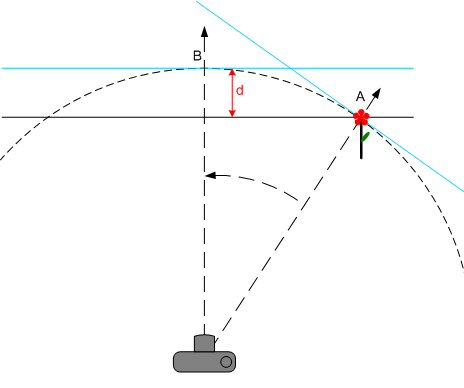 |
The camera is at the base of the diagram. It's first focused on point A. After focus is acquired, everything on the plane of focus that touches point A is in focus (blue line on the right). Then the photographer recomposes - with locked focus - so that the camera points to point B. The focus distance does not change because AF is locked. After that, everything on the plane of focus touching point B appears sharp (blue line on the left). But now point A is no longer on the same plane of focus. The plane of focus that would be correct for A is closer to the camera (solid black line). The amount of misfocus is d (red line), and it becomes larger when you recompose farther. It looks like the camera has a backfocus issue. It also looks like with wide-angle lenses the problem is bigger than with tele-photo lenses. However, this kind of focus error is actually a user error, not a camera problem, and wide-angle lenses just give the user more opportunities to make this mistake than tele-photo lenses (because you can recompose more before the subject slips out of the frame).
There also is a secondary problem when recomposing strongly. The cameras mentioned above often also base exposure and flash exposure on the selected AF sensor, assuming it points at the main subject. So the metering cell(s) close to the selected AF sensor are given priority over the other cells. But when you recompose, the selected sensor no longer points at the main subject, and you may end up with incorrect (flash) exposure.
The lesson to be learned here is to always select the AF sensor closest to the main subject, even if this sensor has a weaker performance than the central sensor. Recomposing by a significant amount should be avoided as much as possible, for accurate focus and correct exposure.
Update from May 11th, 2006
I have received a few messages and read a few forum contributions regarding this article. In some of them the authors expressed doubts that this problem even exists, or they assumed that the focus shift is so small that it can't be seen. So here are a few numbers:
Let's assume we're using a 50/1.4 (not really an exotic lens) on a 35mm camera, resulting in a horizontal angle of view of about 40°. This means you will recompose horizontally by at most 20°. With a focus distance of e.g. 5 m this recomposing will create a focus shift of about 30 cm. This means the focus after recomposing is 30 cm behind point A. The front depth of field in this situation is about 39 cm, which is only slightly more. Such a focus shift is already visible. Make the focus distance slightly shorter, e.g. 2 m, and the focus shift is 12 cm, but the front depth of field is only 6.5 cm. Here the focus shift is almost twice as big as the depth of field.
For the interested, here's the formula to calculate the focus shift:
d = a - a · cos αusing:
- d
- Focus shift
- a
- Distance to point A (= distance to point B)
- α
- Angle of recomposition
The depth of field can be calculated here (but make sure to compare only with the front depth of field, which is the difference between the front edge of the total depth of field and the focus distance).
Update from April 16th, 2008
The following question came up: When you hold the camera in front of your eye and recompose, the center of rotation is your neck, i.e. it is behind the camera's image plane. Does this improve the situation, or does it make things worse?
It depends on what you consider the fixed part in the scenario. If you keep the focus distance constant, then a is unchanged, but the distance between the axis of rotation and A is larger than a. The following illustration shows a comparison:
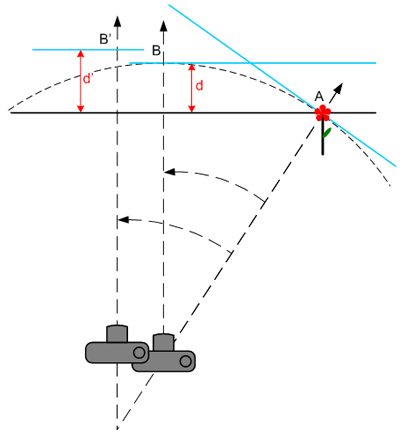 |
The rotation now also moves the image plane, and the displacement of the image plane is added to the displacement of the plane of focus (remember that we still keep the focus distance unchanged when we recompose). In other words, in this situation the focus error is even larger than in the original situation (compare d and d'). But since the distance between the center of rotation and the image plane is short compared to the focus distance, the additional error is also small.
If you consider the distance between your head and the subject the fixed part of the situation (ie. the camera is moved forward and the focus distance is reduced by the same amount), nothing really changes. Look at the first illustration and imagine the camera simply being closer to A and B. The plane of focus before the rotation is the same (we still do focus on the subject), and the plane of focus after the rotation is also where it's illustrated (the original focus distance is reduced, but the added displacement of the image plane compensates for this). The total focus error is the same.
So when the axis of rotation is behind the camera, the focus error is unchanged
or worse, but not smaller.
Categories: Articles, Technique • Archive of all entries